Quick answer: Healthy daily habits start with one decision: which of sleep, movement, food or stress is weakest right now. Fix that one first, keep it steady, then add the next.
This guide helps you make that choice and then build each habit in a realistic order. Each section links to a deeper guide where an exact amount or a step-by-step method matters, so this page stays focused on decisions and conditions.
How to choose your first habit
Start with the area that is most out of balance, not the one that sounds most impressive. A healthy-habits article from Griffin Health gives the same basic instruction: start with one or a few habits and work at them until you have mastered them. A short list you actually repeat beats a long one you cannot keep up.
Three criteria help you pick.
- Size of the gap. If one area is clearly neglected, such as irregular wake times or almost no movement, improving it usually gives the biggest return for the least effort.
- Repeatability. Choose a habit you can do on a bad day. A brisk walk or a glass of water on waking survives a busy schedule better than a long workout.
- Knock-on effect. Sleep, movement, food and stress influence one another. A habit that makes the others easier, such as a steady wake time, is a good opening move.
The criteria sometimes disagree. The largest gap may also be the hardest to act on, for example when work hours make a fixed wake time difficult. In that case, choose the next gap you can repeat on a bad day. A habit you keep is worth more than a perfect ranking you never start.
Match your situation to a starting point
- Your wake time drifts all week. Begin with the sleep section. A fixed wake time is the cheapest change on this page.
- You sit most of the day. Begin with movement, and keep the first step small enough to repeat.
- Meals are improvised or skipped. Begin with food, starting with one reliable meal rather than a full overhaul.
- You feel tense or wound up. Begin with the stress section, which offers a short breathing or meditation practice that needs no equipment.
- You are tired and headachy by afternoon. Check hydration before changing anything else, because it is quick to test.
If none of these fits, or several do, pick the one that feels easiest. Early momentum matters more than a perfect choice, and you can reorder later. The sections below follow a sensible order: sleep as the base, then movement, food, hydration and stress, and finally the routines that hold them together.
Sleep and sleep hygiene
Sleep hygiene means the everyday habits that shape how well you sleep. The clearest starting point is timing: aim to wake up at the same time each day to maintain your body’s circadian rhythm. Anchor the wake time first and let bedtime follow from it.
Fixing the wake time is more practical than fixing the bedtime because you control it directly. You cannot force sleep to arrive on schedule, but you can get up when the alarm sounds. If your current schedule varies a lot, move toward consistency rather than aiming for a perfect pattern overnight.
If shift work, caring duties or travel make a fixed wake time hard to keep, aim for the most consistent wake time your schedule allows and keep it steady across most days. A wake time that stays put is still the anchor, even when the day around it changes.
Decide how much sleep to plan for
Individual needs differ, so the right target is a figure published in guidelines rather than a guess. Our guide on how much sleep do adults need covers the recommended range and what changes it. Use that number to work out a realistic bedtime, then protect the wake time that goes with it. If the hours do not fit between that wake time and your evening, bring the evening forward rather than sleeping in, because a late wake time pushes against the rhythm you are trying to set.
Naps and screens
If you feel the pull of an afternoon rest, the question are naps good for you depends on how and when you nap, and that guide sets out the trade-offs. Evening device use is the other common sleep complication. If screens dominate your night, the practical steps in how to reduce screen time are a good second step after the wake time is settled, and how to reduce eye strain from screens helps if you cannot avoid them during the day.
Movement and aerobic exercise
Regular exercise matters because it reduces your risk of developing health problems such as heart disease, diabetes, and cancer. Aerobic exercise means sustained activity that raises your breathing and heart rate, and most people reach it through walking, cycling or swimming.
The simplest daily version is walking, because it needs no equipment, no booking and no skill. A walk you can repeat on most days is a stronger starting point than one long session you can only manage occasionally. Add it to something you already do, such as a break in the working day or the trip to the shops, so it does not rely on motivation.

How much exercise is recommended each week?
Weekly targets come from national physical activity guidelines, so use the figure your own health authority publishes now rather than a number from a general article. Read that figure as a goal to build toward, not as a limit on effort. If you are currently inactive, begin with whatever you can repeat daily and extend it gradually. If you have a health condition or have been inactive for a long time, ask a clinician how quickly to progress.
For a deeper look at the simplest option, read the benefits of walking every day.
When to add strength work
Aerobic activity is the easier first habit, because you can start it today. Walking suits people starting from low activity and anyone short on time or equipment. Strength work suits people whose walking habit already runs without effort. Add resistance work once the walking habit is stable, rather than starting both at once, which runs against the advice to master a few habits before adding more. Our guide to strength training for beginners at home shows how to begin without a gym.
Food and the balanced plate
A balanced diet is built on a rainbow of fruits and vegetables, and nutrient-dense foods from other food groups. In practice that means many different fruits and vegetables across the week, with the rest of the plate drawn from other food groups and chosen for nutrient content rather than convenience alone.

Judge balance across the week rather than meal by meal. The phrase “a rainbow of fruits and vegetables” gives you a simple test: look back over the last few days and count how many different fruits and vegetables you actually ate. If the number is low, the fix is usually to add variety to meals you already eat, not to rebuild your whole diet.
Start with one dependable meal
Breakfast is the easiest meal to standardise. A healthy breakfast consists of lean protein, fiber, and healthy fats, so choose a version you can repeat without thought, then judge whether it keeps you satisfied. If it does, you have one stable meal and a template for the others. If you rarely have time to cook, a repeatable meal built from the same three parts is more useful than an elaborate plan you abandon.
Go deeper only when you need to
- Fibre intake. If your plate is short on plant foods, how much fiber do you need per day gives the target and the food sources.
- General patterns. For a wider view of everyday eating, see healthy eating habits for adults.
- How you eat. If you eat quickly or on autopilot, what is mindful eating explains a practice that changes pace and attention rather than the menu.
Hydration
Hydration is the habit with the least precise universal rule. How much water your body needs depends on your size, activity level, and where you live, so a fixed volume copied from someone else may suit you poorly.
A practical check works better than a target. Make sure you drink enough fluids to pass urine every few hours. If you are going several hours without passing urine, that is the sign to check your intake. Recheck the answer whenever your activity or your location changes, since both alter how much water you need. The page on how much water should you drink a day adds detail on the factors that change your needs.
The easiest way to build the habit is to attach it to events that already happen: a glass when you wake, a bottle on your desk, a drink with each meal. Do not pile on more than that at the start.
Stress and mindfulness meditation
Stress is a normal part of daily life, and good mental health helps you cope with the daily stresses of life. The aim of a stress habit is therefore not to remove pressure but to give yourself a reliable way to settle after it.
Does meditation reduce stress?
Mindfulness meditation is described as something that can help reduce stress and anxiety. That is a modest, qualitative claim, and the supporting material gives no effect size. Treat meditation as a low-cost practice worth testing for yourself rather than a guaranteed fix, and judge it by how you feel after sessions. If stress feels unmanageable or persists, speak to a clinician rather than relying on a self-help routine.

Choose a stress practice that fits you
- You want something structured. Read meditation for beginners for a first routine and what to expect from it.
- You want something quick during the day. The list in breathing exercises for stress offers methods that fit between tasks. Deep breathing outdoors is also suggested as a break: take up grounding and deep breathing outdoors for stress-relief alternatives.
- Thoughts keep circling. Journaling for stress relief suits people who think better on paper than in silence.
- You feel cooped up. The benefits of spending time in nature pair well with a daily walk, so one outing serves two habits.
Whichever you pick, keep it small. A practice that takes a few minutes and can be done anywhere is more likely to last than a long session that needs the right conditions. Stress habits also sit best next to the others: a calm break after work is easier to protect when the wake time and the evening meal are already steady.

Morning routine as a habit anchor
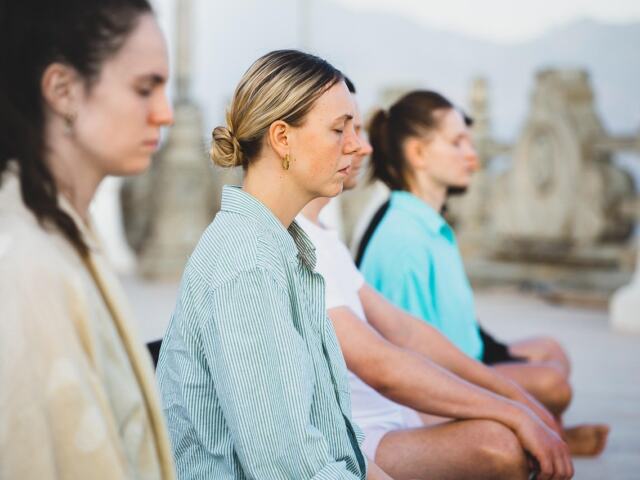
Mornings are useful because the day has not yet filled up. A short sequence that links several habits together reduces the number of separate decisions you have to make. One example is a short silent practice: take the first few minutes to sit peacefully in silence, breathing deeply and slowly. Followed by a glass of water and a repeatable breakfast, that is three habits in one chain.
Build the chain from what you already do. If you already make coffee, put the water glass beside the kettle. If you already wake at a set time, the wake time becomes the first link. The order matters less than the links between the steps, so each habit should cue the next. Our guide to a healthy morning routine lays out ways to assemble these links without making mornings feel crowded.
A morning routine is not essential for everyone. If your mornings are unpredictable because of shift work, children or travel, attach the habits to another reliable moment, such as lunch or the end of the working day. The anchor matters, not the clock time.
How can I build healthy daily habits?
Build them gradually. The core rule is to begin with one or a few habits and master them before adding others, which keeps each new behaviour from competing with the last. The steps below turn that rule into a sequence.
- Pick one habit using the criteria earlier: biggest gap, easiest to repeat, most knock-on benefit.
- Make it small enough to survive a bad day. A walk around the block counts, as does a short breathing pause.
- Attach it to an existing routine, such as waking, a meal or finishing work, so you are not relying on remembering.
- Repeat it until it feels ordinary. The test is that skipping it feels odd, not that you feel motivated.
- Add the next habit only when the first runs without effort. Return to the starting-point list to choose it.
If a habit keeps slipping, shrink it or move it to a different anchor rather than adding pressure. The aim is to keep a habit alive at a lower level rather than drop it altogether. Keep sleep timing, movement, food, hydration and stress practice as the five areas you review; there is little need to add others until these are steady.

Reviewing the five areas
The table below puts the five areas side by side, so you can see the starting point each source gives and a first step that fits it.
| Area | Starting point in the sources | Practical first step |
|---|---|---|
| Sleep | Wake at the same time each day to support the circadian rhythm | Set one fixed wake time and keep it on most days |
| Movement | Regular exercise reduces risk of heart disease, diabetes and cancer | Walk as part of an existing daily routine |
| Food | A balanced diet includes many fruits and vegetables plus nutrient-dense foods | Build one repeatable breakfast with lean protein, fiber and healthy fats |
| Hydration | Water needs vary with body size, activity level and location | Drink enough fluids to pass urine every few hours, and recheck when activity or location changes |
| Stress | Mindfulness can help reduce stress and anxiety | Practise a few minutes of seated, silent, slow breathing |
The starting points come from a Franciscan Health blog post, a Griffin Health blog post and an NAFC blog post, so treat them as general guidance rather than individual advice.
What to check next
Daily habits support health but do not replace medical care. If a symptom, a sustained change in sleep or stress that feels hard to manage worries you, raise it with a clinician rather than waiting for a habit to fix it.
Reassess every so often. If the habits you chose feel automatic, add one more from the list. If one stalls, return to the starting-point questions and ask whether you chose the right area or simply made the step too large. This hub page is the place to return to when you are ready for your next habit.
Frequently asked questions
Do I need a particular diet to eat a balanced diet?
No. The sources describe a balanced diet by its content: a rainbow of fruits and vegetables plus nutrient-dense foods from other food groups. You can check any eating pattern against that description by looking at your plate over several days.
Can not drinking enough water make me feel unwell?
Yes. Dehydration can cause headaches, fatigue, dizziness and even confusion. If you notice these symptoms, drink more fluids, and seek medical advice if they are severe or do not improve.
Should I still have checkups if my habits are good?
Yes. Routine checkups at least once a year are recommended even when you feel healthy, so good habits and regular medical review work together rather than replacing each other.