| Stage | Practice | Length | Planning use |
|---|---|---|---|
| Your first days | Seated breath awareness | 2 to 5 minutes | Begin at the short end. The aim is to make sitting down easy to repeat. |
| Guided options | Recorded guided meditation | 5 to 30 minutes | Choose a short recording first so a voice carries the session. |
| MBSR week 1 | Body scan | 30 minutes daily | A long, guided practice used in a taught course. Try a shorter recording on your own. |
| MBSR week 2 | Sitting meditation, awareness of breath | 10 to 15 minutes per day | A realistic next step once short sits feel routine. |
| MBSR week 4 | Sitting meditation, breath and other physical sensations | 20 minutes per day | A mid-course length for people who already sit regularly. |
| MBSR week 7 | Formal sitting, movement, walking or body scan | 45 minutes daily | A later-course length, not a starting target. |
Course lengths come from the MBSR home practice schedule, and the guided-session range and starter length come from a beginner meditation guide.
Meditation for beginners works best as short, seated sessions of two to five minutes on the breath, lengthened gradually. Your mind will wander, and that is normal rather than a sign you are doing it wrong.
Treat the practice as one of the healthy daily habits that costs very little time. If you want other ways to work with the breath, the breathing exercises for stress cover them. The plan below sticks to plain breath awareness and then branches out.
Setting up your space and posture
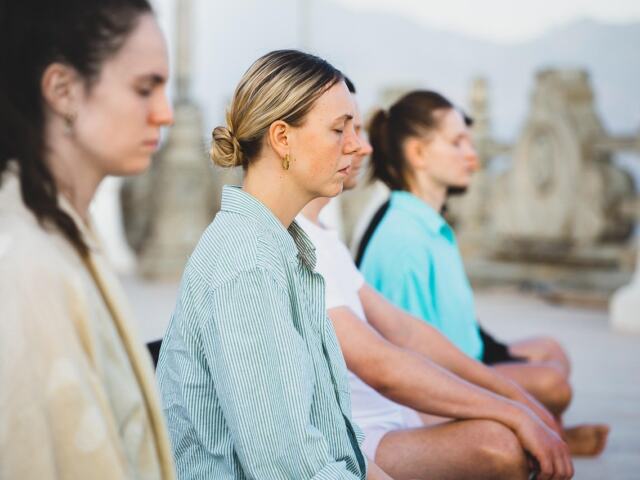
You need a place to sit comfortably and nothing else. Posture guidance for beginners says to sit comfortably, on a chair or a mat, so there is no need to force yourself into a cross-legged floor position. Choose whichever seat lets you stay settled without thinking about your body.

For the breath itself, the same guidance advises letting your body breathe the way it wants to. Beginners often try to control the breath and end up tense. Your job is only to notice it.
Mindfulness versus meditation
Mindfulness is a quality of attention, and meditation is one way of training it. A beginner’s guide defines mindfulness as deliberately paying attention to the present moment without judgment, and describes meditation as a formal practice of mindfulness.
A second beginner guide calls the two interconnected but different concepts. It describes meditation as a more formal, isolated practice. Psych Central frames meditation as using your body and the space around you to become aware of the present moment.
In practice, this gives you two ways to work:
- Formal sessions. You set aside a few minutes, sit, and train attention on the breath. This is what the plan below uses.
- Everyday attention. You bring the same non-judging awareness to ordinary moments. It builds on the formal sessions and does not replace them.
Your first-week practice plan
The plan moves from the shortest sit to a first taste of other styles, with no target beyond showing up. It is a starting structure, so adjust the pace if a stage feels rushed.
Early days: short breath sessions
Use the lower end of the two to five minute starter range. 2 minutes is long enough to notice what your attention does and short enough to repeat daily.
- Set a timer for two minutes and put the phone out of reach.
- Sit comfortably on a chair or mat.
- Let your body breathe the way it wants to, without steering the breath.
- Rest your attention on the breath.
- When you notice your mind has drifted, bring attention back to the breath.
- Stop when the timer sounds, and repeat at a similar time the next day.
Midweek: stretch toward five minutes
Once two minutes feels ordinary, lengthen the sit gradually until you reach five minutes, the top of the same starter range. Keep the same steps and the same timer. Staying at the shorter length for a few more days is a sound choice if sitting still feels uncomfortable. Consistency matters more than minutes at this stage.
End of the week: try a guided session or a body scan
Guided meditation hands the instructions to a voice. Guided meditations are offered from five to 30 minutes, and a 2019 study tested a 10 to 20 minute app-based guided meditation once each workday. Choose the shortest option first. Guided sessions suit people who find silence hard to fill.

A body scan is a technique that lets you scan the entirety of your body, noticing tension as you go. The MBSR home practice assigns a 30-minute body scan daily in week 1. That length is much longer than a solo beginner needs, so a shorter recording is a better first try.
Walking meditation as an alternative to sitting
If sitting is uncomfortable or restless, walking meditation lets you practise while moving. A 2019 review of 25 studies covered moving mindfulness training in outdoor settings. MBSR also lists walking among the formal practices in its week 7 home practice. Treat the walk as the practice itself, with attention on the sensations of moving rather than on where you are headed.

When your mind wanders
A wandering mind is expected, and it is not a failure. Psych Central notes it is natural for your mind to wander and suggests bringing your attention back to your breath. Noticing the drift and returning is the exercise, so each return counts as a repetition.
The beginner guide adds that shutting down your brain should not be your intention. These situations come up often:
- Thoughts keep arriving. Let them be there and return to the breath as many times as needed. Do not try to empty your head.
- You judge the session as bad. That judgment is just another thought. Mindfulness is attention without judgment, so you can notice it and return to the breath.
- You want to work with thoughts directly. MBSR week 2 includes a 15 minute sitting meditation on awareness of thinking. Watching thoughts is a practice in its own right, best tried after the breath feels familiar.
Building up after the first week
A taught program shows how sitting length can grow. MBSR home practice includes 10 to 15 minutes per day of sitting meditation on awareness of breath in week 2, and 20 minutes per day on breath and other physical sensations in week 4. By week 7, participants practise formal sitting, movement, walking or body scan on their own for 45 minutes daily.
Treat these as course patterns, not targets. If you reach the five-minute mark comfortably, moving toward the 10 to 15 minute range is a reasonable next step. Lengthen only when the shorter sit feels routine. The longer course figures describe people who are supported by a teacher and a structured program.
Safety and what the research shows
Meditation is not right for everyone in every form. Beginner guidance advises people with severe depression, borderline personality disorder or schizophrenia to consult their doctor before starting a practice.
A 2018 review summarised by Psych Central reports meditation appears effective for PTSD. It also notes that observing your thoughts and focusing on your breath are not always suitable for trauma survivors. If breath focus feels distressing, talk to a doctor or therapist before continuing rather than pushing through.
The same source describes a 2017 review of 45 studies reporting that meditation effectively lowers stress. Treat that as encouraging and not as a guarantee for any one person. The MBSR program itself states that it is not psychotherapy and is not a substitute for therapy, and the same limit applies to a home practice.
Noting how a session felt
Writing a few words after a session is optional, but it helps you see patterns, such as when sitting felt easier or harder. Keep the note short and factual. If you enjoy writing, journaling for stress relief pairs well with a short sit.

Frequently asked questions
Is meditation a religious practice?
No. A beginner’s guide describes meditation as a completely secular practice that has nothing to do with religious belief.
What is MBSR and who developed it?
Mindfulness-Based Stress Reduction (MBSR) is a stress-reduction program pioneered by Jon Kabat-Zinn. Its home practice schedule is a handy reference for how session lengths can grow.
Why use a timer?
A timer removes the need to check a device during practice, as the beginner guide points out. That keeps your attention on the breath and not on the clock.