
A reader running on short nights and strong coffee asks how much sleep do adults need. Most adults need 7 or more hours each night, and the typical range is 7-9 hours.
This guide covers the amount of sleep, how it shifts with age and what falling short looks like. The schedule and routine side sits with the healthy daily habits hub.
Recommended sleep hours for adults
The US Office of Disease Prevention and Health Promotion states that most adults need 7 or more hours of sleep each night. Its guidance was adapted from materials by the Centers for Disease Control and Prevention and other US health agencies. Harvard Health puts the amount most people sleep at seven to nine hours. Seven hours is the floor in every version of the guidance. Nine is the top of the usual range and not a target to chase.
Adults up to age 65
A health-system guide from ThedaCare says healthy adults need a minimum of 7 to 9 hours per night up to age 65. For most working-age adults, then, the practical question is whether nights regularly reach 7 hours. Within the range, the right figure is the one at which you stay alert through the day.
Adults over 65
Harvard Health notes that as people get older, the average amount of sleep decreases to 7-8 hours. That describes what older adults typically get, and it does not necessarily mean the need has fallen. HealthPartners states that adults at any age need seven to nine hours, so the range does not simply drop after 65. Sources differ slightly on the top end for older adults, but 7 hours stays the lower mark either way.
Sleep itself also changes. HealthPartners reports that deep sleep starts to decline from about age 55, and that sleep changes commonly begin in the 50s and 60s. An older adult who sleeps 7-8 hours and feels alert is within the typical pattern. One who sleeps that long and still feels worn out should treat the tiredness as the signal, not the clock.
Teenagers follow a different range. The same federal guidance gives 8 to 10 hours for ages 13 to 17, so the adult range does not apply to anyone under 18.
Common misunderstandings about sleep need
Most confusion comes from mixing up three things: what people average, what the guidance recommends and how someone feels. The table sets the usual beliefs against what the evidence supports.
| Common belief | What the guidance supports | Planning use |
|---|---|---|
| “Fewer than 7 hours is enough if I cope.” | Most adults need 7 or more hours each night, and several studies associate fewer than 7 hours with obesity. | Treat 7 hours as a minimum to aim for. |
| “Need shrinks sharply with age.” | The average amount slept falls to 7-8 hours in older age, while most people sleep 7-9 hours overall. | Use the same lower mark, and judge by daytime alertness. |
| “Feeling tired always means I need more hours.” | Still feeling tired after sleeping the recommended number of hours is listed as a sign of a possible sleep disorder. | If tiredness persists at 7 or more hours, raise it with a clinician instead of adding time in bed. |
Figures come from MyHealthfinder and Harvard Health.
- An average is not a requirement. The 7-8 hour figure for older adults reports what people tend to get. Use it as context for your own pattern, not as a replacement for the recommended range.
- An association is not proof of cause. Harvard Health notes that several studies link obesity with sleeping fewer than seven hours a night. It also points out that cause and effect are hard to establish for sleep and life expectancy. Short sleep is a reason for attention, not a prediction about any one person.
Body clock and sleep timing
Circadian rhythm is the body’s internal timing system. MyHealthfinder explains that your body sets its biological clock according to the pattern of daylight where you live. The hour guidelines say how long to sleep, while the clock is tied to when daylight arrives and fades. Duration and timing are separate questions, and a night can fail on either.
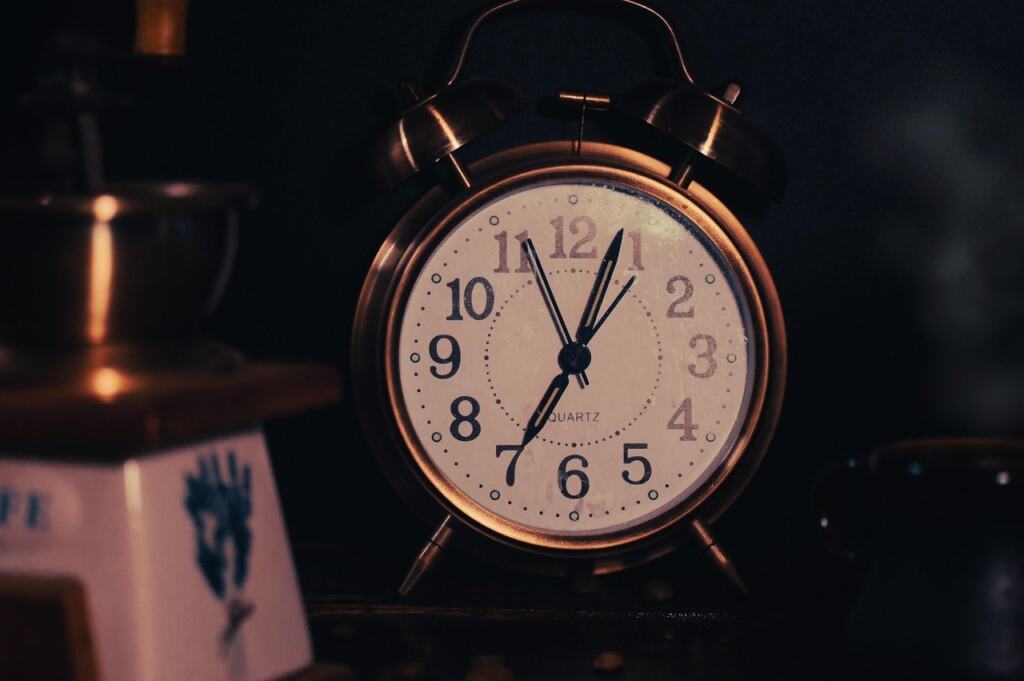
When you check your own nights, count the time you actually spend asleep, not the time between getting into bed and the alarm. Practical routines for setting that window belong to the wider wellness hub.
Signs you are not getting enough sleep
The clearest sign is how you function in the daytime. MyHealthfinder lists sleepiness during the day that makes it difficult to do everyday activities, like driving or concentrating at work as a warning sign. Treat that as the test that matters, because a reading of hours alone cannot tell you whether your own need is being met.

Two other signs come from the same federal page, and both point to something beyond simple short nights:
- Tiredness despite enough hours. Still feeling tired after sleeping the recommended number of hours is listed as a sign of a sleep disorder.
- Trouble sleeping despite changes. Difficulty falling or staying asleep, even after making healthy changes to your sleep routine, is another sign to take to a clinician.
These three signs lead to different decisions. Daytime sleepiness with short nights points to a shortfall in hours. Tiredness at 7 or more hours, or trouble sleeping after routine changes, points to a medical conversation. People who spend long hours on screens can mistake tired eyes for general tiredness. For that separate problem, see how to reduce eye strain from screens.

What short sleep does to attention and health
Adequate sleep helps you, in the federal guidance’s words, think more clearly, form long-term memories, and do better in school and at work. Short sleep works against each of those. The most concrete safety consequence is on the road: the same page states that drowsy drivers cause thousands of car accidents every year.
Longer-term health is a matter of association. ThedaCare notes that a lack of proper sleep can contribute to serious health problems, including obesity, lowered immunity, heart problems, diabetes and depression. Harvard Health adds that several studies associate obesity with sleeping fewer than seven hours a night. Read these as reasons to protect the 7-hour floor rather than as exact risks. If you are drowsy while driving, the practical choice is not to drive until you are alert.
Sleep need versus sleep debt
Sleep need is the nightly amount that keeps you alert and functioning, and sleep debt is the gap that builds when nights fall short of it. The guideline ranges describe a nightly amount, so a run of short nights is a shortfall against your usual need and not a sign that the need has gone down.

A longer weekend sleep may feel restorative, but one morning cannot show whether your need is being met. A better check is your daytime function over ordinary weeks. If you are alert at 7 or more hours on most nights, your pattern is within the guidance. If you need long lie-ins to function, your usual nights are probably too short, and that is the pattern to fix.
Extra time in bed does not solve every case. Persistent tiredness at the recommended hours, or trouble sleeping after routine changes, is a reason to see a clinician. Daily movement belongs to the same wider routine, and benefits of walking every day covers that side.
Frequently asked questions
| Question | Answer |
|---|---|
| Is 7 hours enough for an adult? | For most adults, yes. Seven hours is the minimum in the federal guidance, and the typical range runs 7-9 hours. What counts is feeling alert in the daytime. |
| Do teenagers need the same amount as adults? | No. Ages 13 to 17 need 8 to 10 hours each night, according to MyHealthfinder. |
| At what age does deep sleep start to decline? | HealthPartners reports that deep sleep begins to decline at about age 55. Sleep changes commonly start in the 50s and 60s. |
| When should tiredness be checked by a clinician? | When you still feel tired after the recommended hours, or when you have trouble falling or staying asleep even after healthy changes to your routine. Both are listed as signs of a possible sleep disorder. |